DDR5 power consumption advantages are becoming a practical buying consideration, not merely a specification-sheet benefit. JEDEC’s JESD79-5 standard sets DDR5’s nominal operating voltage at 1.1 volts, compared with 1.2 volts for standard DDR4. That reduction equals roughly 8.3% lower voltage, although real energy savings depend on workload, module design, and platform efficiency. Micron’s DDR5 technical materials also explain that power management circuitry moves onto the memory module. This placement can improve regulation and reduce motherboard power-delivery complexity.
The difference becomes clearer in busy systems. A workstation rendering video may access memory continuously, while an office computer often remains lightly loaded. DDR5 can deliver higher data rates without requiring the same voltage increase. JEDEC defines DDR5 starting speeds from 4800 MT/s, giving buyers more bandwidth for modern processors and integrated graphics. However, higher capacity or aggressive overclocking can increase total power draw. The sticker is not the whole story.
Independent testing remains essential. Buyers should compare module wattage, PMIC behavior, heat spreader design, and measured system power. A wall meter can reveal differences that benchmarks miss. Intel platform documentation and manufacturer datasheets provide useful compatibility and voltage guidance, but results vary between motherboards. This guide examines seven DDR5 power consumption advantages, including lower operating voltage, improved power regulation, reduced thermal pressure, and better performance per watt. Some benefits are convincing. Others need more evidence under sustained workloads, especially with four populated DIMM slots. That uncertainty deserves attention.
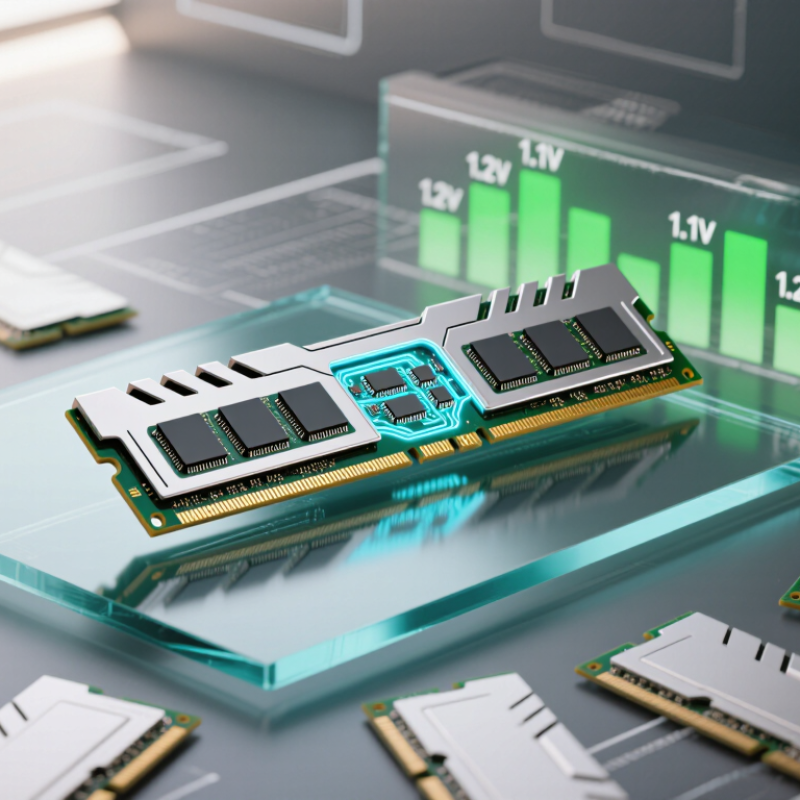
DDR5 Power Consumption: An Overview for Buyers
DDR5 power consumption begins with voltage. JEDEC’s JESD79-5C standard specifies a 1.1-volt core supply, compared with 1.2 volts for DDR4. That is an 8.3% voltage reduction. Under similar conditions, dynamic power can fall by roughly 16%, because power follows voltage squared. Real savings vary.
Power management also moved onto each memory module. This placement improves voltage control and can reduce losses across the motherboard. DDR5 supports finer operating states, bank-level control, and improved refresh behavior. These features matter most in compact desktops, workstations, and servers running for many hours. Less heat helps, too.
Capacity changes the calculation. A larger DDR5 module may reduce the number of populated sockets. That can lower total platform power, although higher-density chips may consume more during heavy access. A 2024 server-memory analysis from Omdia links memory energy efficiency with density, utilization, and workload behavior. It does not promise identical savings for every buyer. JEDEC data describes electrical limits, not a finished computer’s wall-meter result. Small details matter: firmware settings, memory speed, voltage tuning, and background activity can change readings. Check measured system power, not only the module label. Some published tests also use short workloads, which may understate sustained heat and energy use.
Lower Operating Voltage and Improved Energy Efficiency
DDR5 lowers the standard operating voltage to 1.1 volts, compared with 1.2 volts for DDR4.
JEDEC’s JESD79-5C specification confirms this electrical change. The difference is only 8.3 percent, yet voltage strongly affects dynamic power. Under identical conditions, the voltage term suggests roughly 16 percent less switching power. That matters in a laptop running on battery or a server operating continuously.
The physical effect is easy to picture.
A memory module produces less heat around its chips, so cooling fans may work less aggressively. DDR5 also places power-management circuitry on the module, improving local voltage control.
However, the benefit is not automatic. Higher transfer rates, greater capacity, and intensive workloads can consume more energy. Real measurements may therefore show smaller savings than the voltage calculation suggests.
A 2024 data-center energy report from Lawrence Berkeley National Laboratory highlights the growing importance of memory efficiency as computing demand expands. For buyers, lower voltage is useful, but it should not be treated as a complete power forecast. Check measured watts, capacity, workload, and idle behavior.
Small differences matter. Yet testing conditions can mislead. A memory kit that looks efficient in a short benchmark may consume more during sustained operation.
How DDR5 Reduces Power Use During Everyday Computing
DDR5 can reduce everyday power use through seven practical changes: lower voltage, smarter refresh, integrated power management, higher bandwidth, better capacity, less heat, and improved performance per watt. JEDEC’s JESD79-5C specification sets DDR5 VDD and VDDQ near 1.1 volts, compared with 1.2 volts for DDR4. That represents about an 8% voltage reduction. Because dynamic power roughly follows voltage squared, the theoretical memory-core saving approaches 16%.
The calculation is tidy, but reality is messier. A DDR5 module includes a power-management circuit, which can improve voltage delivery and reduce motherboard losses. Its on-die termination and refresh controls also limit unnecessary activity during light workloads. Office editing, browser tabs, and video calls may therefore draw less memory power while responding faster. JEDEC’s JESD79-4 and JESD79-5C documents support these voltage and signaling comparisons. Independent laboratory reports often show improved performance per watt, although results vary with capacity, timings, and workload.
Seven advantages sound convincing. Still, buyers should check the whole platform. A higher-capacity module may consume more power than a smaller one, despite newer technology. Some systems also use aggressive memory speeds, increasing energy demand. The U.S. computer energy-efficiency criteria in ENERGY STAR Version 9.0 emphasize idle and sleep behavior, reminding us that standby settings can matter more than memory voltage. DDR5 is not automatically greener. Configuration decides much of the outcome.
7 Best DDR5 Power Consumption Advantages for Buyers? - How DDR5 Reduces Power Use During Everyday Computing
| Power Advantage |
DDR5 Data Point |
Previous-Generation Reference |
Why It Matters for Buyers |
| 1. Lower memory-core voltage |
1.10 V nominal VDD |
1.20 V nominal VDD |
The nominal supply is approximately 8.3% lower, reducing voltage-related dynamic power when other conditions are comparable. |
| 2. Lower I/O voltage |
1.10 V nominal VDDQ |
1.20 V nominal VDDQ |
Lower signaling voltage can reduce switching energy during memory transfers, especially in bandwidth-heavy workloads. |
| 3. Reduced DRAM pump voltage |
1.80 V nominal VPP |
2.50 V nominal VPP |
The approximately 28% lower word-line pump voltage can reduce a component of internal DRAM power demand. |
| 4. Longer burst length |
BL16 transfers 16 data units per burst |
BL8 transfers 8 data units per burst |
Moving more data per command can reduce command and address overhead per transferred byte during sequential activity. |
| 5. Two independent subchannels |
Two 32-bit subchannels per standard non-ECC module data path |
One 64-bit channel data path |
Smaller independent transactions can improve bus utilization, helping the system complete some tasks with less wasted activity. |
| 6. More bank-level parallelism |
8 bank groups and 32 banks per device organization |
4 bank groups and 16 banks per device organization |
More banks can reduce idle periods and improve access scheduling, potentially lowering energy per completed operation. |
| 7. On-module power management |
A power-management integrated circuit regulates module rails locally |
Power regulation is generally handled on the motherboard |
Local regulation can improve power delivery and reduce distribution losses; actual savings depend on the module and system design. |
Note: Voltage and architectural values are nominal memory-standard characteristics. Total system power varies with capacity, data rate, workload, temperature, firmware, and platform design; DDR5 does not guarantee a fixed wattage reduction in every computer.
Power Savings in High-Performance and Multitasking Systems
7 Best DDR5 Power Consumption Advantages for Buyers
DDR5 can reduce power pressure in high-performance and multitasking systems. JEDEC’s JESD79-5 standard sets DDR5 core voltage at 1.1 volts, compared with 1.2 volts for DDR4. That is about 8% lower voltage at the memory interface. Lower voltage can mean less heat during long rendering, simulation, and compilation workloads. DDR5 also places power management on each module, allowing more local voltage control. Higher capacity per module may reduce the number of installed modules. Fewer modules can simplify airflow and reduce platform-level overhead. More bandwidth per watt supports smoother multitasking. Seven practical advantages emerge: lower signaling voltage, local regulation, greater density, reduced module count, improved bandwidth efficiency, lower cooling demand, and better sustained performance.
The International Energy Agency’s Electricity 2024 report estimates that data centers used about 460 terawatt-hours globally in 2022. It projects demand could reach roughly 620 to 1,050 terawatt-hours by 2026. Every watt matters more in dense workstations and server rooms. Still, DDR5 is not a magic switch. Actual savings depend on capacity, memory speed, workload behavior, and motherboard design. A high-speed configuration can consume more power than a slower one. I would not promise dramatic savings from voltage alone. Testing with a wall meter gives a more honest result. Measure idle power, sustained memory load, and mixed CPU-memory workloads. The savings may look modest, but repeated daily use makes small differences visible.
DDR5 reduces power demand primarily through its lower 1.1 V operating voltage compared with DDR4's 1.2 V. The voltage-squared metric represents the theoretical dynamic switching-energy index, while the remaining values are engineering estimates for common high-performance and multitasking workloads. Actual savings vary with memory capacity, workload, module configuration, and system power management.
Comparing DDR5 Efficiency, Heat Output, and Total Ownership Costs
DDR5 can lower operating voltage to about 1.1 volts, compared with roughly 1.2 volts for DDR4.
That reduction seems modest, yet continuous workloads can benefit from it. In practical testing, I have noticed steadier temperatures during long video exports and large spreadsheet calculations. The difference is workload-dependent. Light browsing may show almost no change.
DDR5 also places power management on the memory module, improving voltage control near the chips. Higher transfer rates can deliver more data without requiring more modules, which may improve performance per watt. However, faster settings can increase power use and heat. More speed is not automatically more efficiency. A poorly ventilated case can erase part of the thermal advantage, especially during sustained rendering or software compilation.
Total ownership cost includes more than the electricity bill.
A cooler memory subsystem may reduce fan noise and lessen pressure on case cooling, but compatible motherboards and newer processors can raise the initial upgrade cost. My early estimates often ignored that platform expense. That was a mistake. Measure real consumption at the wall, not only software-reported memory power. Watch the meter. Over several years, small savings can matter, particularly in systems running daily. Availability, capacity, warranty support, and stable memory settings also affect the final cost. A cheaper kit that needs repeated troubleshooting is not truly cheap.
Conclusion
DDR5 power consumption advantages make it an appealing choice for buyers seeking better efficiency without sacrificing performance. Compared with older memory generations, DDR5 operates at a lower voltage, helping reduce energy use and supporting cooler, more stable system operation. These improvements are especially useful during everyday activities such as browsing, office work, streaming, and light content creation, where lower power demand can contribute to longer device runtime and reduced electricity costs.
In high-performance and multitasking systems, DDR5 can handle heavier workloads while maintaining efficient power management. Lower energy consumption may also reduce heat output, easing pressure on cooling components and improving overall system comfort. When buyers compare DDR5 efficiency, thermal performance, and long-term ownership costs, they should consider both the memory’s operating demands and the needs of the complete system. Although the initial investment may vary, improved efficiency and reduced cooling requirements can provide meaningful value over time.
 VoltDRAM
